Lab 9: External Interrupt (EXTI)
Learn hardware interrupt handling - respond to GPIO events instantly without polling. This is a core embedded system skill.
Learning Objectives
By the end of this lab, you will:
- 🎯 Understand interrupt concept and architecture
- 🎯 Configure EXTI (External Interrupt) lines
- 🎯 Use SYSCFG to map GPIO to interrupt lines
- 🎯 Write interrupt handler functions
- 🎯 Enable NVIC interrupts for instant response
Prerequisites
- ✅ Complete Lab 4 (debouncing)
- ✅ Understand GPIO input reading
- ✅ Familiar with interrupts concept
Hardware Required
| Component | Details |
|---|---|
| Microcontroller | STM32F407VG |
| Button | PA0 user button |
| LED | PD12 red LED |
Theory: Interrupt Architecture
Polling vs Interrupts
Polling (what we've done):
  while (1) {
      if (button_pressed) {
          // Expensive: checking constantly
      }
  }
  Problem: Wastes CPU time and energy checking

Interrupt (Lab 9):
  // Hardware detects button automatically
  Interrupt fires → CPU jumps to handler → Executes code
  Problem: None - CPU free until event happens!
EXTI System
GPIO Button (PA0)
  ↓
SYSCFG (maps PA0 to EXTI0 line)
  ↓
EXTI0 detector (rising edge, falling edge, both)
  ↓
Interrupt controller (NVIC)
  ↓
Interrupt handler function (EXTI0_IRQHandler)
Configuration Steps
1. Enable GPIO clock
2. Configure pin as input (MODER = 00)
3. Enable SYSCFG clock (APB2)
4. Map GPIO to EXTI line (SYSCFG_EXTICR1)
5. Unmask EXTI line (EXTI_IMR)
6. Set edge trigger (EXTI_RTSR for rising edge)
7. Enable interrupt in NVIC (NVIC_ISER0)
8. Write __attribute__ handler function
9. Clear interrupt flag in handler (EXTI_PR)
Demo
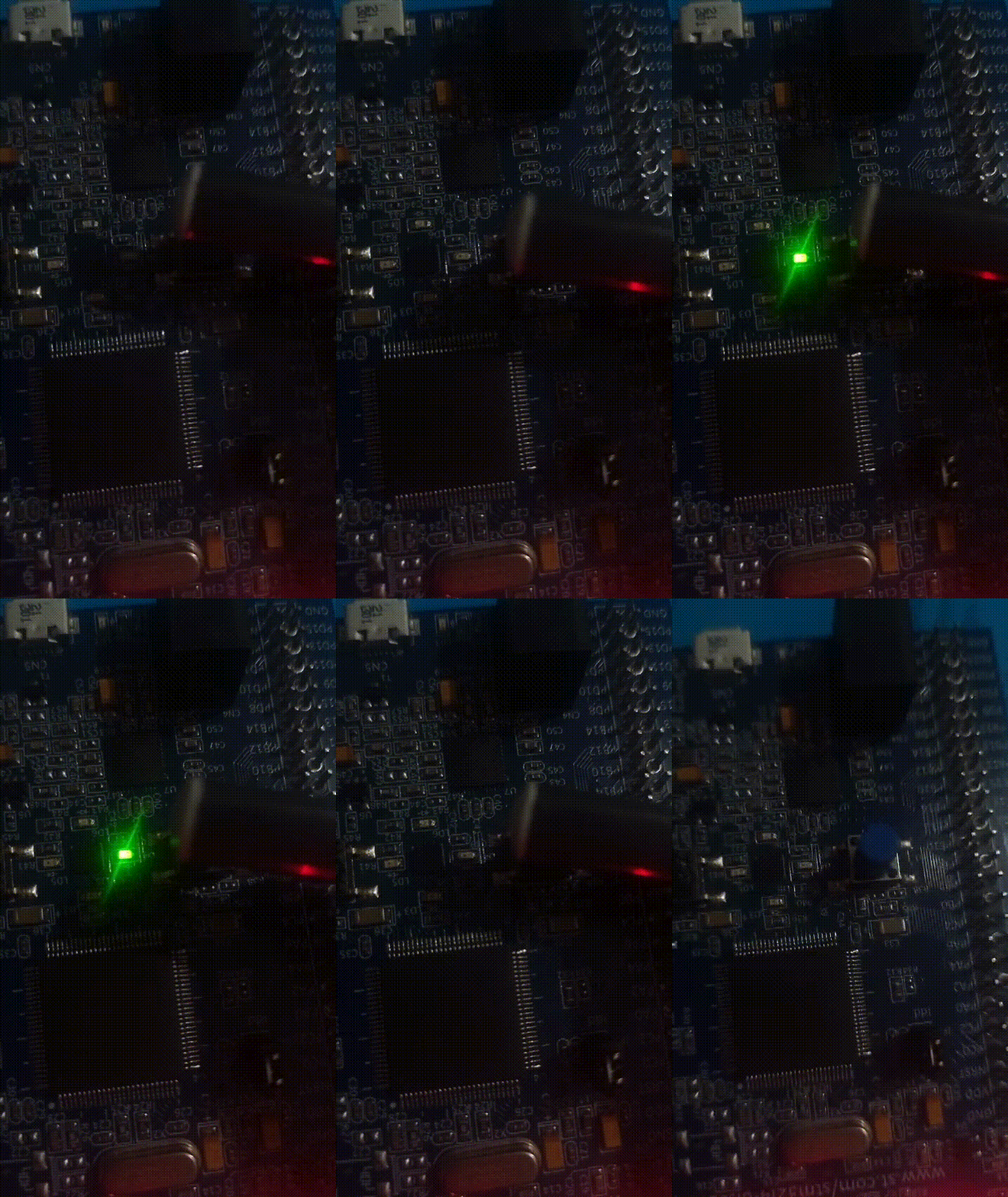
Button press → Instant LED toggle via interrupt handler
Complete Code
#define RCC_AHB1ENR *(volatile unsigned int*)(0x40023800 + 0x30)
#define RCC_APB2ENR *(volatile unsigned int*)(0x40023800 + 0x44)

#define GPIOA_MODER *(volatile unsigned int*)(0x40020000 + 0x00)
#define GPIOD_MODER *(volatile unsigned int*)(0x40020C00 + 0x00)
#define GPIOD_ODR   *(volatile unsigned int*)(0x40020C00 + 0x14)

#define SYSCFG_EXTICR1 *(volatile unsigned int*)(0x40013800 + 0x08)
#define EXTI_IMR       *(volatile unsigned int*)(0x40013C00 + 0x00)
#define EXTI_RTSR      *(volatile unsigned int*)(0x40013C00 + 0x08)
#define EXTI_PR        *(volatile unsigned int*)(0x40013C00 + 0x14)
#define NVIC_ISER0     *(volatile unsigned int*)(0xE000E100)

// Interrupt handler called when PA0 triggers
void EXTI0_IRQHandler(void) {
    if (EXTI_PR & (1 << 0)) {
        // Clear pending flag
        EXTI_PR |= (1 << 0);

        // Toggle LED
        GPIOD_ODR ^= (1 << 12);
    }
}

int main(void) {
    // Enable GPIO clocks
    RCC_AHB1ENR |= (1 << 0);  // GPIOA
    RCC_AHB1ENR |= (1 << 3);  // GPIOD

    // PA0 as input
    GPIOA_MODER &= ~(3 << 0);

    // PD12 as output
    GPIOD_MODER &= ~(3 << 24);
    GPIOD_MODER |= (1 << 24);

    // Enable SYSCFG clock
    RCC_APB2ENR |= (1 << 14);

    // Map PA0 to EXTI0
    SYSCFG_EXTICR1 &= ~(0xF << 0);  // Clear bits [3:0]
    // Leave as 0000 for GPIOA selection

    // Unmask EXTI0 (allow interrupt)
    EXTI_IMR |= (1 << 0);

    // Rising edge trigger (button HIGH)
    EXTI_RTSR |= (1 << 0);

    // Enable EXTI0 in NVIC (interrupt 6)
    NVIC_ISER0 |= (1 << 6);

    // Loop (CPU now responds to interrupts)
    while (1) {
        // Can do other work here
        // Interrupt will trigger automatically
    }

    return 0;
}
How It Works
Setup:
  ├─ PA0 configured as input
  ├─ SYSCFG maps PA0 → EXTI0
  ├─ EXTI0 watches for rising edge
  ├─ EXTI0_IRQHandler registered
  └─ NVIC enabled for EXTI0

User presses button:
  PA0 goes HIGH → Hardware detects → Interrupt fires!
    ↓
  CPU saves state
    ↓
  Jumps to EXTI0_IRQHandler()
    ↓
  Handler toggles LED
    ↓
  Handler clears pending flag
    ↓
  CPU resumes main loop
Expected Output
User Action:
├─ Press PA0 button
│  └─ Interrupt fires instantly
│  └─ LED toggles immediately
│  └─ No debouncing yet (see Challenge 1)
├─ Release button
│  └─ Another interrupt may fire (false trigger)
└─ Pattern repeats
Common Mistakes
| Issue | Solution |
|---|---|
| No response | Enable SYSCFG clock (RCC_APB2ENR) |
| Wrong pin | Verify SYSCFG_EXTICR1 configuration |
| Multiple toggles | Add debouncing in handler |
| Interrupt never fires | Check NVIC_ISER0 - enable correct IRQ |
Key Takeaways
✨ Important:
- SYSCFG maps GPIO to EXTI lines
- EXTI detects edge conditions
- Interrupt handler runs automatically
- Must clear flag to prevent retriggering
- NVIC enables interrupt in CPU
Challenge Exercises
Challenge 1: Debounced Interrupt
Add debouncing within the handler function.
Challenge 2: Multiple Buttons
Use PA1 with EXTI1 for second button independently.
Challenge 3: Interrupt Counting
Count how many times interrupt was triggered, display on LEDs.
Next Steps
🚀 Ready for Lab 10? Learn LCD display interfacing to show text and data on screen!
Prerequisites for Lab 10: GPIO control, Parallel communication basics